Ambeo Smart Headset Specs, Features, and Value: Is it worth the price tag?
In the rapidly evolving landscape of consumer audio, innovation often focuses on output—how music sounds to the listener. However, the Ambeo Smart Headset shifts the focus toward input, offering a unique proposition that bridges the gap between high-fidelity playback and professional-grade spatial recording. Developed as a collaboration between specialized audio giant Sennheiser and Apogee, known for their industry-leading digital audio conversion, this headset is designed not just for those who want to hear the world, but for those who want to capture its three-dimensional reality. In this deep dive, we explore whether this niche piece of hardware justifies its existence and its cost in a market saturated with standard noise-canceling alternatives.
Understanding Binaural Audio and the Ambeo Vision
To appreciate the Ambeo Smart Headset, one must first understand binaural recording. Traditionally, recording immersive audio required expensive "dummy head" microphones—silicone ears with microphones embedded at the eardrum position to mimic how human biology filters sound. The Ambeo Smart Headset miniaturizes this concept by placing high-quality omnidirectional microphones on the outside of each earpiece. When a user wears the headset and hits record on their mobile device, they are capturing sound exactly as they hear it. When played back through any pair of headphones, the listener experience is startlingly realistic: sounds appear to come from behind, above, and around the head with pinpoint accuracy.
Sennheiser’s goal with this product was to empower mobile content creators—vloggers, travelers, and sound designers—with the ability to document "sonic memories." For a buyer, the value proposition lies in the marriage of a high-end Lightning-connected earphone and a 3D audio recording rig that fits in a pocket.
Core Specifications and Technical Architecture
The technical foundation of the Ambeo Smart Headset is a sophisticated chain of hardware components. Because the device utilizes a Lightning connector (designed primarily for iOS devices), it bypasses the internal digital-to-analog and analog-to-digital converters of the smartphone. Instead, it relies on Apogee’s proprietary "PureDigital" technology. This ensures that the audio signals being sent from the microphones to the phone, and from the phone to the drivers, remain pristine and free from the interference often found in standard headphone jacks.
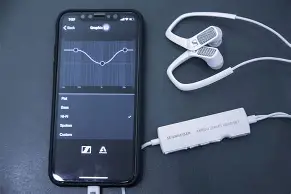
The microphones themselves are omnidirectional, designed to capture the nuance of environmental sound without the "proximity effect" that can muddy directional mics. On the output side, the drivers are tuned for a balanced, clear frequency response that prioritizes accuracy over the bass-heavy "V-shape" typical of consumer buds. This neutral tuning is essential for monitoring recordings, as it allows the creator to hear exactly what is being captured without artificial coloration.
Active Noise Cancellation and Transparent Hearing
Beyond its recording capabilities, the headset functions as a standard pair of noise-canceling earphones. Sennheiser utilizes the external binaural mics to power its "Transparent Hearing" feature. This allows users to blend their music with the sounds of their environment. Unlike many competitors where transparency feels artificial or "hissy," the Ambeo’s implementation is exceptionally natural because the mics are positioned exactly where your ears are. This creates a seamless transition between the digital audio and the physical world.
The Active Noise Cancellation (ANC) is effective, though it may not reach the absolute silence offered by dedicated over-ear flagship models. However, for an in-ear design, it does a commendable job of neutralizing low-frequency hums, such as airplane engines or subway tracks, making it a viable travel companion regardless of whether you intend to record audio.
Real-World Use Cases: Where the Ambeo Shines
While standard headphones are passive consumption devices, the Ambeo Smart Headset is a tool. Understanding its value requires looking at how it performs in specific scenarios that matter to modern buyers.
1. The Travel Documentarian
Imagine walking through a bustling market in Marrakech or the quiet redwood forests of Northern California. A standard smartphone microphone captures a flat, noisy mono or stereo signal that lacks depth. Wearing the Ambeo headset allows a traveler to film video while capturing a 360-degree soundscape. When watching that video later, the clinking of tea glasses feels like it is happening two feet to the right, and the wind rustling through leaves feels like it is passing overhead. For those who value immersive storytelling, this is a transformative feature.
Looking for the best Audio & Headphones deals on Amazon?
Browse Now →2. Concerts and Live Events
Capturing live music on a phone usually results in distorted, clipped audio. The Apogee integration in the Ambeo headset includes a "Soft Limit" feature. This acts as an automated gain control, preventing digital clipping even in high-decibel environments. Recording a live band with this headset results in a clear, spatial representation of the venue’s acoustics that feels like "being there" in a way no standard phone mic can replicate.
3. ASMR Creators and Sound Designers
The rise of ASMR (Autonomous Sensory Meridian Response) has created a demand for high-quality spatial audio. The Ambeo headset provides an entry-level professional solution for creators to produce binaural content without investing thousands in 3DIO microphone rigs. Sound designers also use the device for "field foley," capturing environmental textures for use in film or game production.
Feature Breakdown and Ergonomics
The design of the headset is distinct. It features an "over-ear" hook design, which is necessary to keep the binaural microphones stable and properly oriented toward the front. While some users find ear hooks cumbersome, they provide a secure fit during movement and help reduce "cable microphonics"—that annoying thumping sound you hear when a headphone cord rubs against your clothing.
The inline remote is larger than average because it houses the advanced Apogee converters and a programmable "rocker switch." This switch can be mapped via the dedicated Ambeo app to trigger specific functions, such as toggling between levels of transparency or launching a specific recording app. This level of hardware customization is a significant quality-of-life feature for power users.
Pros and Cons
- Unrivaled Binaural Recording: It remains the most accessible and high-quality way to capture 3D audio on a mobile device without bulky external equipment.
- Apogee Digital Conversion: The integration of high-end AD/DA converters ensures that playback and recording quality far exceed standard 3.5mm or basic Lightning adapters.
- Natural Transparent Hearing: The "Situational Awareness" mode is remarkably transparent, making it safe for commuters and cyclists who need to hear traffic.
- Build Quality: Sennheiser is known for durability, and the Ambeo feels robust, with reinforced stay-fit ear hooks and high-quality plastics.
- Software Support: The accompanying app is intuitive, allowing for easy firmware updates and customization of the ANC and recording parameters.
- Limited Connectivity: The Lightning-only connector is a major drawback for Android users or those moving toward USB-C iPad models and newer iPhones.
- Specific Fit: The over-ear hook style isn't for everyone and can be uncomfortable for those who wear glasses over long periods.
- Battery Drain: Because it draws power for ANC and high-res converters directly from the phone, it can lead to faster battery depletion than passive headphones.
Market Comparison: How It Stands Up
In the audio market, the Ambeo Smart Headset occupies a unique "island." It doesn't compete directly with standard Bluetooth buds like AirPods Pro, nor does it compete with studio headphones. Its competition is usually a combination of separate devices. Below is a comparison to help visualize where it fits in the hierarchy of mobile audio solutions.
| Feature | Ambeo Smart Headset | Standard Premium ANC Buds | Pro Field Recording Rig |
|---|---|---|---|
| Audio Recording | 3D Binaural (High Fidelity) | Mono/Stereo (Standard) | Multi-track/Ambisonic |
| Portability | High (Pocket-sized) | Highest (Ultra-compact) | Low (Requires bags/stands) |
| Primary Connector | Lightning | Bluetooth / USB-C | XLR / TRS |
| Ease of Use | Plug-and-play with iOS | Seamless for consumption | Complex setup required |
| Price Category | Mid-Range/Specialized | Consumer High-End | Professional/Expensive |
Buying Guide: Is It Right For You?
Deciding whether to purchase the Ambeo Smart Headset comes down to whether you view audio as a two-way street. Before making the investment, consider the following questions.
First, evaluate your device ecosystem. If you are an Android user, this headset is essentially a non-starter without cumbersome and often unreliable adapters. For iPhone users with Lightning ports, it offers a seamless "it just works" experience. However, with Apple's transition to USB-C on the iPhone 15 and beyond, the longevity of this hardware depends on your willingness to use dongles or maintain an older device specifically for field recording.
Second, ask yourself how often you record video or audio. If 99% of your headphone use is listening to Spotify on the bus, you are paying a significant premium for recording technology you won't use. You would be better served by Sennheiser’s Momentum series or other dedicated noise-canceling headphones. However, if you find yourself constantly recording voice memos, filming Instagram Reels, or wanting to capture the atmosphere of your travels, the "cost per use" of the spatial recording feature becomes very attractive.
Find top-rated Audio & Headphones products at great prices.
See Deals →Third, consider the acoustic environment you inhabit. The Ambeo is a specialist in "atmosphere." It is less about capturing a single voice (like a lapel mic) and more about capturing a place. If your goal is to record clear interviews in noisy cafes, a directional shotgun mic for your phone might be a better tool. If your goal is to let your audience feel like they are standing in that cafe with you, the Ambeo is the correct choice.
Technical Considerations for Professional Results
For those who do choose the Ambeo, there are technical nuances to maximizing its value. When recording, the position of your head becomes the "camera" for the audio. Turning your head quickly will "pan" the audio for the listener, which can be disorienting if the video doesn't match. Professional users often practice smooth, deliberate head movements to ensure the spatial audio remains immersive rather than nauseating. Furthermore, because the mics are omnidirectional, wind noise can be an issue. Using the included windscreens (small foam covers) is essential for outdoor recording, even if it makes the headset look a bit more "utility" and less "fashion."
The Question of Value: Is it Worth the Price?
When the Ambeo Smart Headset first launched, its price point placed it firmly in the premium category. Today, its value is seen through the lens of its uniqueness. There are very few products that offer this specific combination of technologies. If you were to try and replicate this setup using separate components, you would need to buy a pair of binaural microphones (like those from Soundman or Roland), a mobile audio interface with phantom power or battery support, and a pair of monitoring earbuds. Such a setup would be significantly more expensive, far more fragile, and involve a mess of cables.
In this context, the Ambeo is actually a bargain for the right user. It is an "all-in-one" solution that democratizes a type of recording that was previously the domain of experimental musicians and high-budget sound engineers. For the average consumer looking for "just headphones," the price tag might seem steep compared to the latest wireless offerings. For the creator, the price is a reasonable entry fee into a new dimension of content creation.
Conclusion
The Ambeo Smart Headset is a rare example of a company taking a genuine risk to bring a professional niche technology to the consumer market. It is not a "perfect" product—the tether to the Lightning port and the specific ear-hook design make it a targeted tool rather than a universal one. However, what it does, it does with exceptional grace. It offers a portal into the world of spatial audio that is both high-fidelity and remarkably simple to use.
Whether it is worth the price tag depends entirely on your relationship with your environment. If you view the sounds around you as something to be ignored, this isn't the headset for you. But if you see the sound of a city at night, the roar of a stadium, or the whispers of a forest as something worth preserving in all its three-dimensional glory, the Ambeo Smart Headset stands alone. It remains a benchmark for mobile binaural recording and a testament to the power of high-quality audio engineering in the smartphone age.